
Home

REACT Spotlight
‘Reinforcement learning–based framework for whale rendezvous via autonomous sensing robots‘ has been published in Science Robotics (2024).

Prof. Stephanie Gil gets selected as a DARPA Young Faculty Award recipient for 2024
REACT Lab publication “Learning Trust Over Directed Graphs in Multiagent Systems” accepted for oral presentation at the 2023 Learning 4 Decision and Control at UPenn.
REACT Lab PhD candidate, Sushmita Bhattacharya, named 2022 Apple Scholar in AI/ML PhD fellowship in Fundamentals of Machine Learning
Prof. Stephanie Gil and her team developed a control mechanism for teams of robots to automatically calculate the tradeoffs of maintaining a resilient communication network and achieving their mission goal.
The Navy’s Science and Technology program awards REACT Professor, Stephanie Gil, with the Office of Naval Research Young Investigator Award
REACT Lab research featured in Harvard Magazine
REACT Lab publication “Multi-robot Adversarial Resilience using Control Barrier Functions” achieves nomination for Best Paper Award at the 2022 RSS Conference
Selected as a 2020 Sloan Research Fellow
Recipient of the NSF CAREER Award 2019!
(Official ASU announcement link) NSF CAREER: “Multi-Agent Decision Making and Optimization using Communication as a Sensor”
Security for Multi-Robot Systems

Read about our research on security for multi-robot systems from MIT News
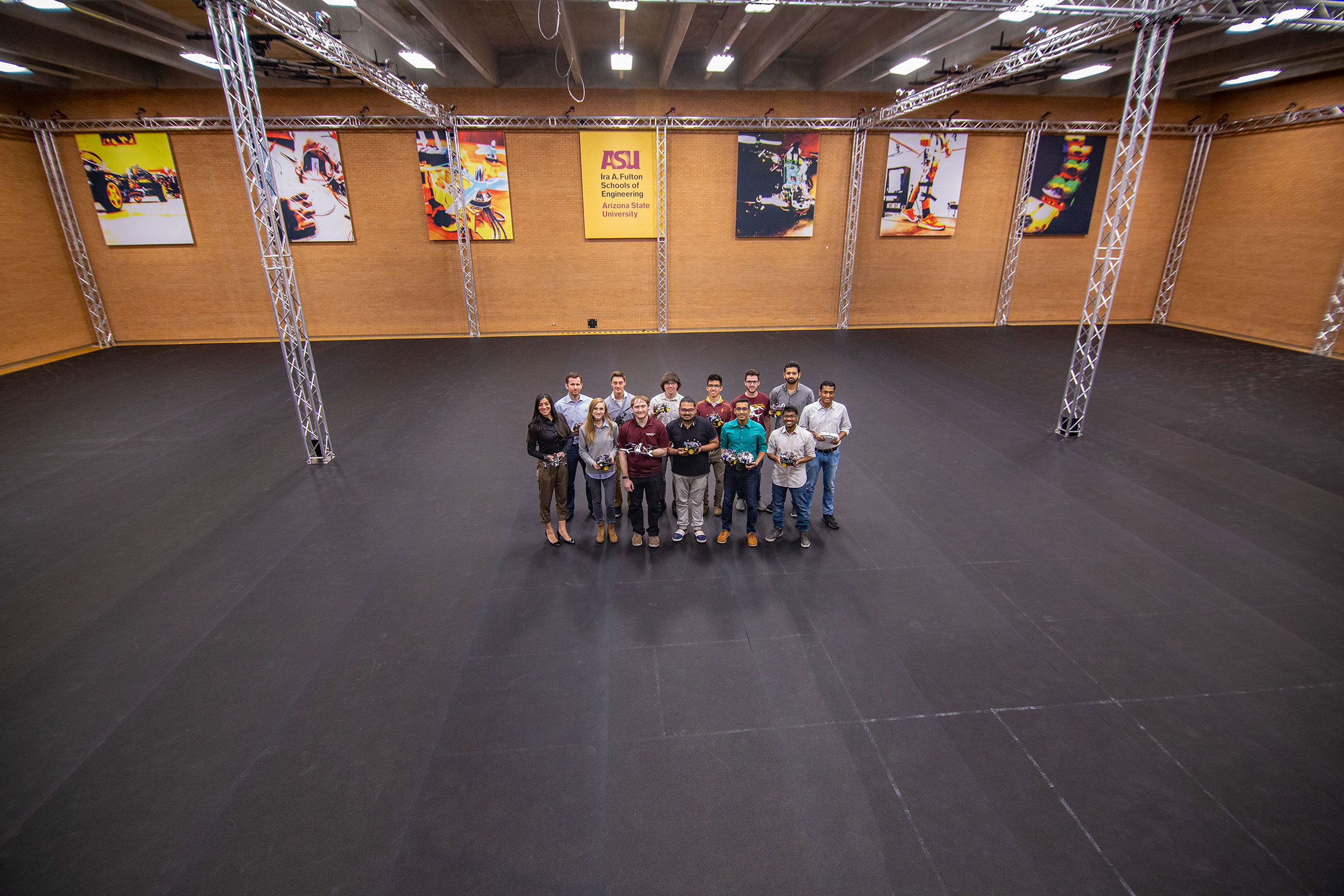
ASU Drone Studio Unveiled
As one of the vision leads for this new testbed Professor Gil is proud to say that ASU now has one of the largest drone research testbeds in academia! See the official announcement for more information.
Program Chair SWRS 2019
Professor Gil served as the Program Chair for the Southwest Robotics Symposium 2019 with over 600 registrants, invited speakers from 13 universities, 5 topic areas in robotics, and plenary talks by Oussama Khatib and Ruzena Bajcsy!
FURI Research
Congratulations to our REACT Lab members Paul Vohs, Thomas Wheeler, and Maxwell Flanagan whose research proposals were selected for FURI 2018/2019!

Robotics, Embedded Autonomy & Communication Theory (REACT) Lab

Our goal is to develop and analyze algorithms for robust multi-robot coordination where communication is used as a key enabler to achieving this goal. The key to effective coordination is information exchange. Our research looks at ways that use wireless signals to improve communication in multi-robot teams, enhance situational awareness, and secure core multi-agent algorithms. We are interested in applications of our research to positioning systems indoors, human-robot collaboration, and making robot-robot teams robust and secure against cybersecurity threats. Most generally, our work centers around trust and coordination in multi-robot systems. Prof. Gil has been granted an NSF CAREER award (2019) and has been selected as a 2020 Sloan Research Fellow. She also held a Visiting Assistant Professorship at Stanford University (2019) where she was working with the Stanford Robotics Lab. Please see links to our work that has been reviewed in MIT News, as well as several other news outlets including Wired and the Forbes!

Our REACT Lab Heterogeneous Air/Ground Testbed
…where we do fast algorithm prototyping and testing for multi-robot decision making and control

Our Students
Our students learn to control robots, track them using our new motion capture lab, and program them to work collaboratively using communication as a sensor for intelligent decision-making.
Our Research


JOIN US!
We are always looking for talented and motivated PhD, M.S., and B.S. students to join our team. Email sgil@seas.harvard.edu with your CV and list of relevant current and past projects!
Check Us Out on YouTube!
Recent Publications Fast Distributed Optimization over Directed Graphs under Malicious Attacks using Trust Multi-Robot Adversarial Resilience using Control Barrier Functions Reinforcement Learning-Based Framework for Whale Rendezvous via Autonomous Sensing Robots Community Consensus: Converging Locally Despite Adversaries and Heterogeneous Connectivity Projected Push-Pull for Distributed Constrained Optimization Over Time-Varying Directed Graphs Exploiting Trust for Resilient Hypothesis Testing with Malicious Robots
Recently Invited Talks
Trust in Multi-Robot Systems and Achieving Resilient Coordination
University of Illinois Robotics Seminar, UIUC
April 2022
Situational Awareness and Secure Coordination for Multi-Robot Teams Early Career Spotlight: IEEE Multirobot Systems (MRS)
Cambridge, UK
November 2021
Trust in Multi-Robot Systems and Achieving Resilient Coordination, Plenary: IEEE Colombian Conference on Automatic Control (CCAC)
Colombia
October 2021
Trust in Multi-Robot Systems and its role in Achieving Resilient Coordination
University of California San Diego (USC) Controls Seminar, UCSD
May 2021
Information Theory Forum at Stanford University
July 2019
Control and Robotics Seminar Series at UC Berkeley
July 2019
Robotics Lunch Colloquium at Stanford University
June 2019
Learning for Decision and Control (poster) at MIT
May 2019
Robotics Colloquium at the University of Washington
April 2019
Blockchain for Robotics MIT Media Lab
December 2018
Presentation of our new L-CSS paper “Resilient Multi-Agent Consensus using Wi-Fi Signals” at CDC
December 2018
CCIS colloquium at Northeastern University
November 2018
View Our Research













Photo credits: Adobe Stock, Yingyaipumi and Kinwun