

Our Research
Our Team
Robotics, Embedded Autonomy, and Communication Theory
Harvard University
Trust and coordination in multi-robot systems, from provable foundations to deployment in real-world settings.
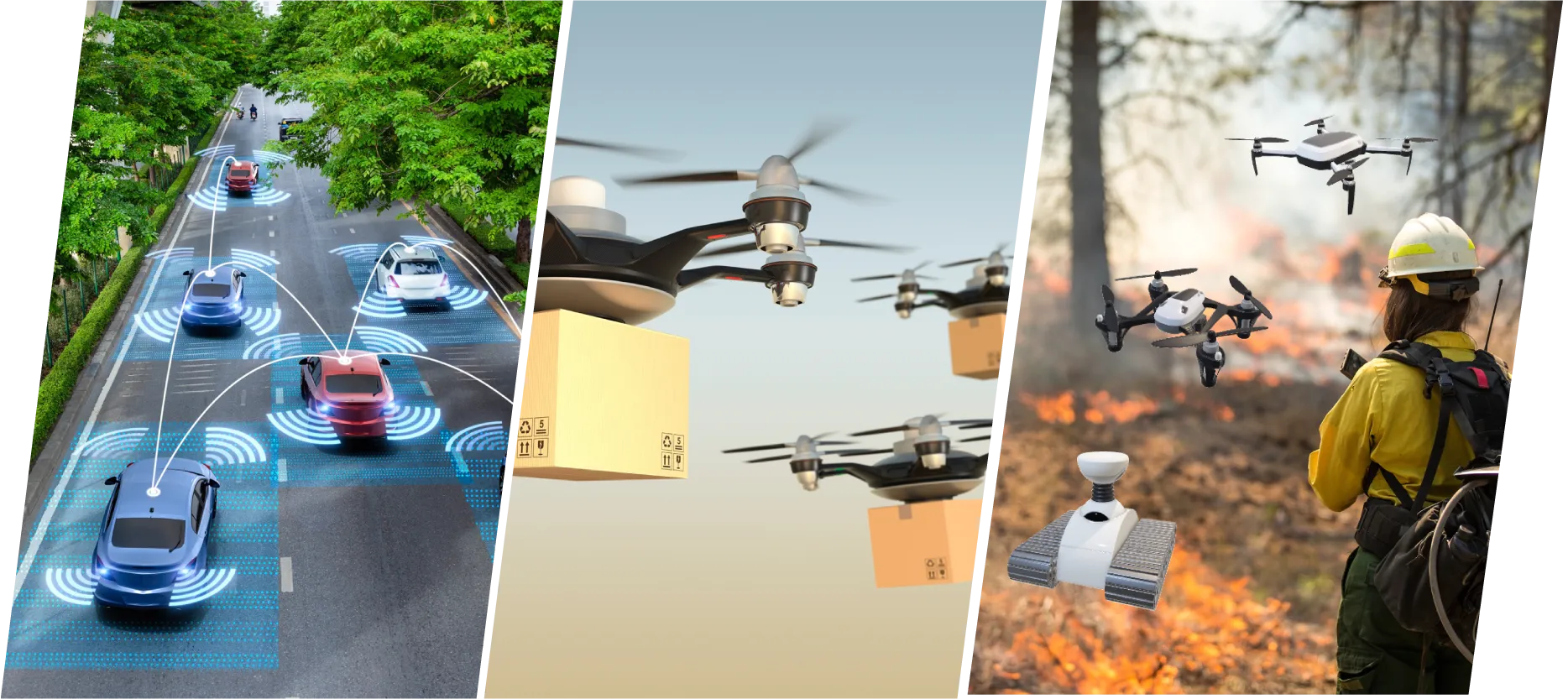
Our goal is to develop and analyze algorithms for robust multi-robot coordination, deriving the algorithmic and mathematical foundations of trustworthy multi-robot autonomy. A key objective of our work is to bridge theory and practice, obtaining foundational results that translate to robots operating in the real world. Our research spans three interconnected thrusts. A novel observation underpinning much of our work is that physicality itself can serve as a foundation for sensing and trust. This perspective drives our work on communication as a sensor, where the wireless signals robots already exchange double as a source of relative position and context, enabling new forms of sensing for robotics, from multi-robot SLAM in featureless environments to localization without external infrastructure. We derive methods for resilience in multi-robot coordination that allow teams to establish trust over their communication networks and provably withstand malicious or faulty robots in tasks such as consensus, flocking, and distributed optimization. And we design multi-robot sequential decision making algorithms that scale planning under uncertainty to large teams, with applications from autonomous ride-sharing in cities to autonomous rendezvous with sperm whales in the open ocean. Most generally, our work centers around trust and coordination in multi-robot systems, bridging robotics, communication theory, and learning.